Confused Between TATA Harrier Diesel vs Harrier EV? Here’s the Right Choice for You
Confused between Tata Harrier Diesel and Harrier EV? Compare performance, mileage, range, cost, features, and suitability to choose the right Harrier based on your driving needs and lifestyle.
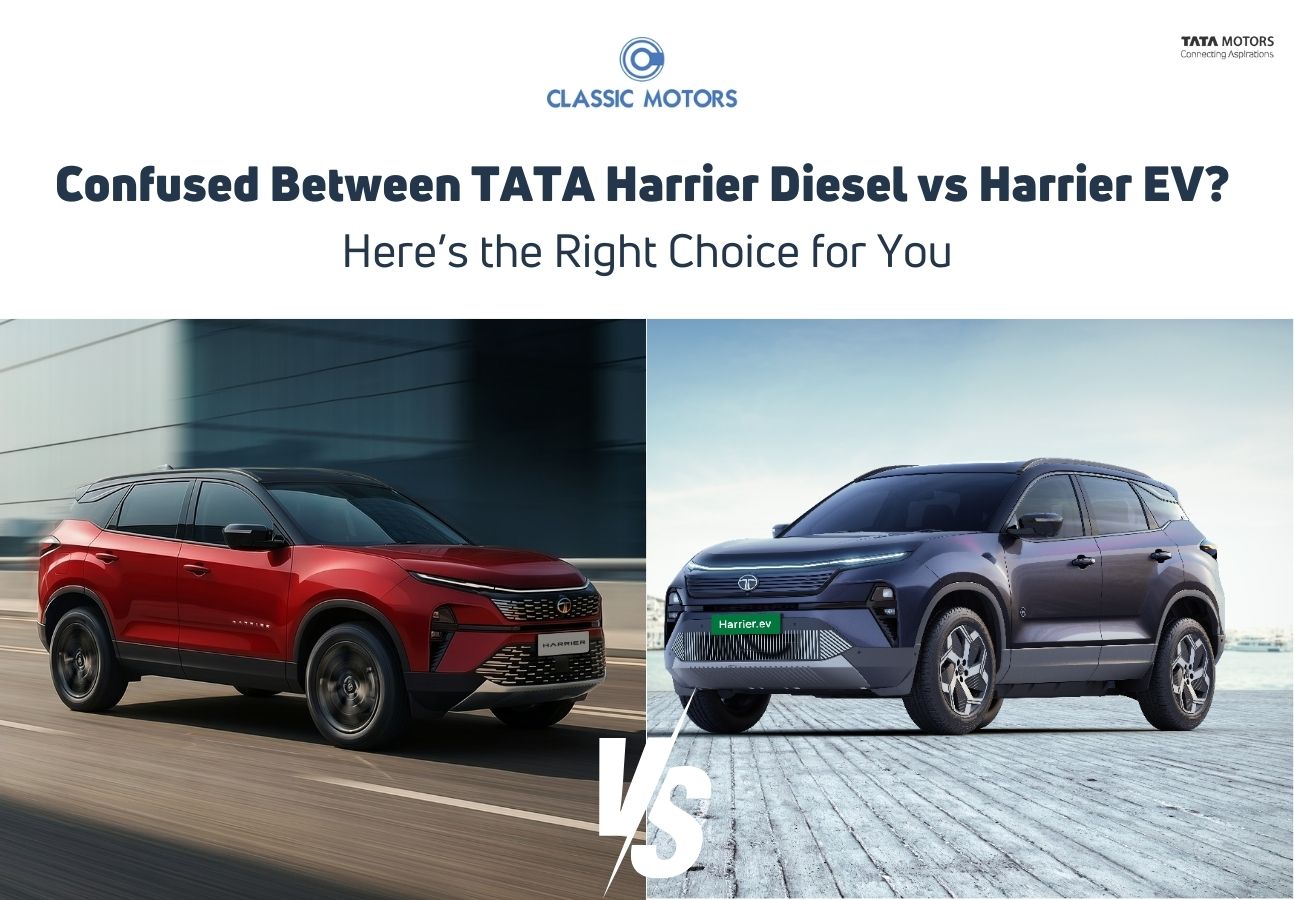
TATA Motors offers the Harrier in two very different directions today: the updated diesel-powered Harrier and the all-electric Harrier EV. Both are built on the same SUV identity but differ in styling details, powertrain technology, equipment, and ownership requirements.
If you are deciding between them, the right choice depends on how you drive, how far you travel regularly, and what kind of usage you expect over the next few years. This guide explains the key differences using official model information and published specifications.
Powertrain & Performance: Diesel vs Electric
The diesel Harrier continues with a Fiat-sourced 2.0-litre BS6.2 diesel engine producing 170hp and 350Nm. It is available with a 6-speed manual or a 6-speed torque converter automatic. Drive modes include Eco, City, and Sport. It remains front-wheel drive.
Key TATA Harrier Diesel specifications include strong mid-range performance and a wide powerband. Refinement is improved, but the diesel still has audible engine sound at low speeds and under hard acceleration.
On the other hand, the electric Harrier is built with a re-engineered floor and a new electrical architecture called t.idal (TATA Intelligent Digital Architectural Layer). It comes in two layouts:
- Rear-wheel drive (RWD) with a permanent magnet motor
- All-wheel drive (AWD) with an additional front induction motor
The top AWD version produces 313hp and 504Nm (dual motor), while RWD versions are rated at 238hp and 315Nm.
Range, Charging & Daily Running
Diesel buyers will typically focus on efficiency and tank range. The Harrier diesel has a published figure of TATA Harrier mileage at 16.8 kmpl (as listed in reference data). Actual results depend on driving conditions and variant.
EV buyers will focus on range and charging time. The Harrier EV is offered with 65kWh and 75kWh battery packs. The stated TATA Harrier EV range includes:
- 627km (ARAI) for 65kWh
- 622km (ARAI) for 75kWh
On a real highway-heavy drive, the 75kWh version covers roughly 414km.
Charging details include:
- 120kW DC fast charging: 20% to 80% in about 25 minutes (claimed)
- 7.2kW AC charging: up to 10.7 hours for 75kWh (10% to 100%)
The Harrier EV also supports V2L (vehicle-to-load) and V2V (vehicle-to-vehicle).
Design & Cabin Differences You Should Know
The diesel Harrier has received a comprehensive facelift with updates to lights, bumpers, grille, and connected LED DRLs. Wheel sizes now range from 17-inch to 19-inch based on the variant.
Inside, the updated Harrier gets:
- New steering wheel with illuminated TATA logo
- New 10.25-inch digital driver display
- New 12.3-inch touchscreen
- Wireless Android Auto and Apple CarPlay
- Dual-zone climate control
- Panoramic sunroof
- Ambient lighting and JBL sound modes (higher variants)
The Harrier EV design changes are subtle, including a closed grille, revised bumper area, new aero alloys, EV badges, and no tail pipe.
Interior in the Harrier EV is largely shared but includes:
- New 14.5-inch Neo QLED touchscreen
- Different gear selector
- Circular key fob with control features including Summon mode
Features & Safety: What Each One Offers
This is where a detailed Harrier EV vs Diesel features check becomes important. Both versions are well-equipped, but the EV introduces new technology-focused functions.
Harrier Diesel safety highlights include:
- 6 airbags, ESC, traction control, 3-point belts for all seats
- ISOFIX mounts, TPMS
- ADAS (camera + radar based) on higher variants
Harrier EV safety and tech highlights include:
- 7 airbags
- Level 2 ADAS calibrated for Indian roads (as claimed)
- 540-degree camera with transparent bonnet feature
- Digital rearview mirror
- Auto parking and Reverse Assist
Both versions have a 5-star Bharat NCAP rating (as stated in reference content).
Price & Purchase Planning in Alwar and Bhiwadi
The Harrier diesel is listed at ₹14.98–₹29.95 lakh (on-road). The EV is listed at ₹22.83–₹30.74 lakh (on-road). Ex-showroom EV prices are noted from Rs 21.49 lakh to Rs 28.99 lakh depending on variant.
This is the easiest place to do a clear TATA Harrier comparison based on budget planning, charging setup readiness, and expected usage.
For updated TATA Harrier EV price, variant availability, and dealership-specific schemes, buyers can contact Classic Motors, including the TATA showroom in Alwar and the TATA showroom in Bhiwadi. Final billing can also vary due to TATA Car Prices and limited-period TATA car price offers, depending on location and time of purchase.
The Right Choice Comes Down to Your Driving Pattern
If your usage involves long highway travel with quick refuelling convenience, the diesel Harrier fits that requirement using a conventional powertrain. If your usage is city-heavy or mixed, with planned charging access and priority on EV-specific features, the Harrier EV matches those conditions.
Both options are part of the wider TATA Car SUV range and are available across multiple trim levels and equipment packages.